
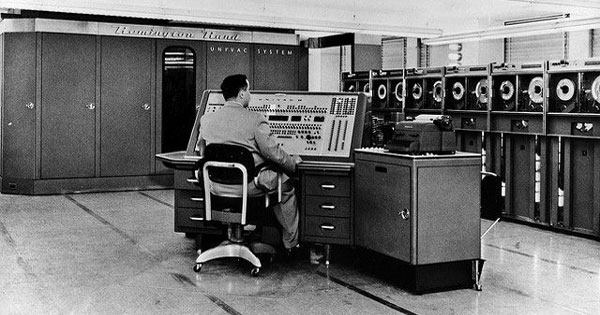
As part of ongoing research into early naval computing activities at the Philadelphia Naval Shipyard (PNSY), two independent primary sources provide important corroborating evidence of UNIVAC system deployment and operational use at the site.
While much early computing work conducted under Navy contracts was classified or minimally documented publicly, later unclassified summaries and oral histories often preserve operational details that help reconstruct what occurred.
Office of Naval Research Documentation
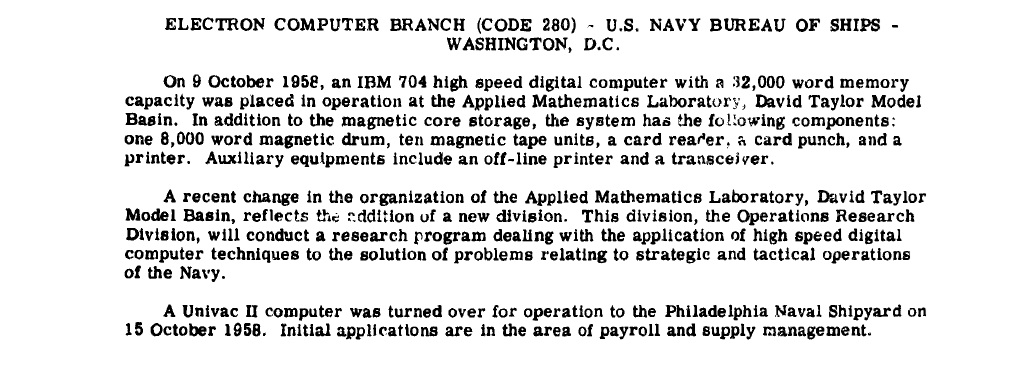
A 1959 Office of Naval Research publication from the U.S. Navy Bureau of Ships reports that:
“A Univac II computer was turned over for operation to the Philadelphia Naval Shipyard on 15 October 1958. Initial applications are in the area of payroll and supply management.”
This statement establishes that a UNIVAC II system was formally operational at PNSY by October 1958, confirming the shipyard as an active Navy computing site during the period when civilian contractors and engineers were routinely involved in system delivery, installation, testing, training, and maintenance.
Although described in administrative terms, such installations typically required extensive engineering support both before and after turnover.
Oral History Corroboration
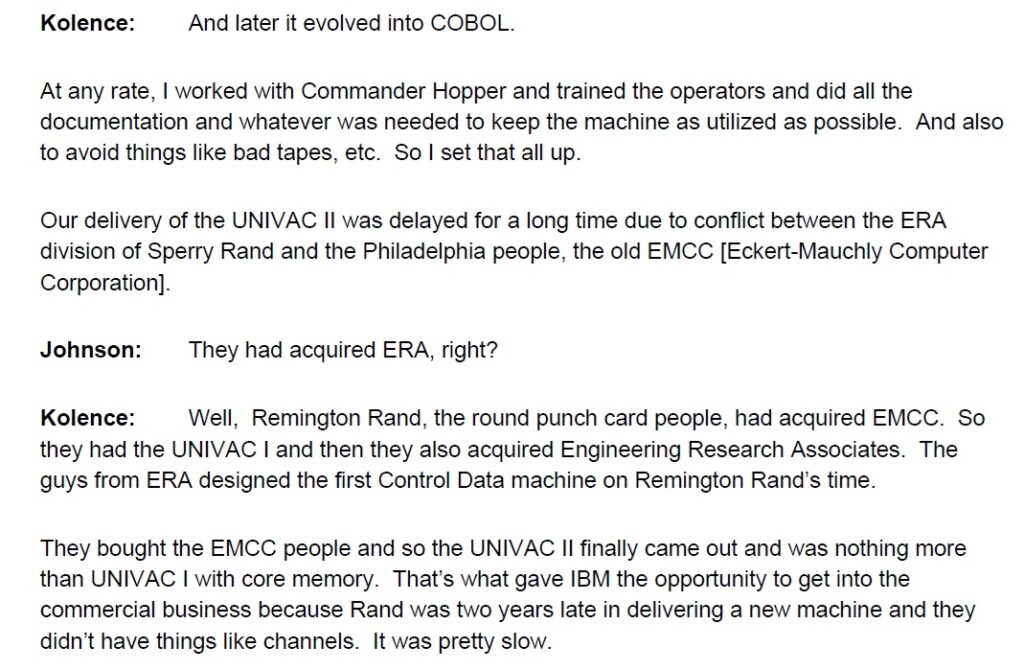
An oral history interview with Kenneth Kolence, a UNIVAC engineer whose career spanned the Eckert-Mauchly, Remington Rand, and Sperry Rand transitions, further supports this context.
In the interview, Kolence describes working with Commander Grace Hopper, training operators, producing documentation, and addressing operational issues associated with UNIVAC II deployment. He explicitly references delays and organizational conflict between the ERA division of Sperry Rand and the Philadelphia-based Eckert-Mauchly organization during the delivery of UNIVAC II systems.
Taken together, these sources independently confirm:
- UNIVAC II operational presence at the Philadelphia Naval Shipyard
- Ongoing engineering, training, and documentation activity
- Corporate and organizational continuity from EMCC through Remington Rand and Sperry Rand
- The complexity and intensity of Navy-driven computing deployment during this period
These findings do not, by themselves, document every aspect of earlier classified activity. They do, however, establish a credible, documented foundation for understanding the technical and institutional environment in which early naval computing work occurred at PNSY.