
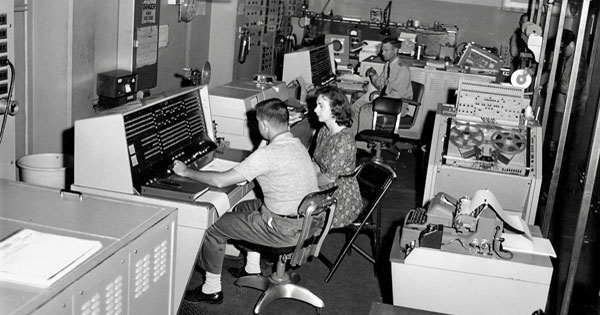
The Naval Tactical Data System and the Engineering Mandate of 1955–1962
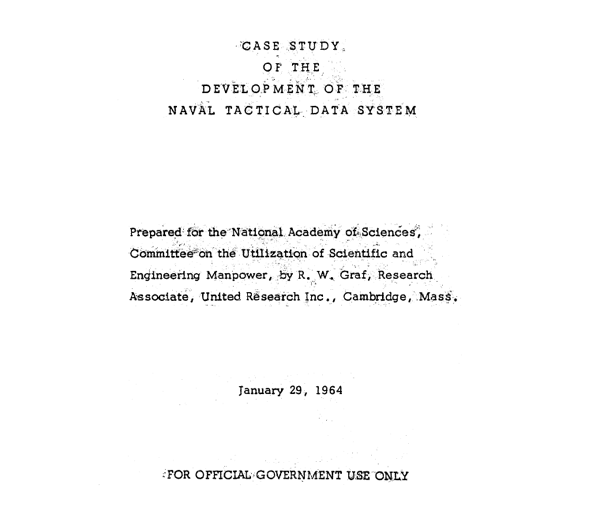
In January 1964, a formal case study was prepared for the National Academy of Sciences examining the development of the Naval Tactical Data System (NTDS). The report describes NTDS as:
“a large scale, complex, military command and control system whose introduction into the fleet is having far-reaching effects.” Case Study of the Development o…
The development phase, covering 1955 through 1961, was considered a success because it produced a functioning operational system “within a fairly tight time and cost framework.” Case Study of the Development o…
That phrase — fairly tight time and cost framework — reveals something critical.
This was not leisurely research.
It was accelerated Cold War systems engineering.
The Strategic Imperative
By the mid-1950s, naval command systems were struggling to keep pace with new threats. The report explains that modern warfare — involving high-speed aircraft and missile systems — had outgrown manual plotting and voice communication methods.
The NTDS was designed to operate in “real-time,” meaning:
“Information exchange and the presentation of the tactical situation had to take place at a high enough rate to be of value to the operator… one which appears to be instantaneous and causes no practical degradation to tactical information because of time of computation or presentation.” Case Study of the Development o…
In the 1950s, real-time digital computing at sea was not standard practice. It required:
- Analog-to-digital conversion equipment
- High-speed digital computing systems
- Random-access stored-program architecture Case Study of the Development o…
- High-rate communications links
- Integrated visual display consoles
- Modular “building block” construction for multiple ship classes Case Study of the Development o…
This was systems integration at a scale rarely attempted in naval history.
From Concept to Fleet in Six Years
The development phase ran from mid-1955 to 1961 Case Study of the Development o….
Major milestones included:
- Technical requirements completed (Fall 1955)
- Contracts awarded to Remington Rand Univac, Hughes Aircraft, and Collins Radio (1956) Case Study of the Development o…
- Delivery of R&D equipment beginning 1958 Case Study of the Development o…
- Experimental testing at NEL (1959–1961) Case Study of the Development o…
- Fleet installation aboard USS Oriskany, USS King, and USS Mahan (1961) Case Study of the Development o…
Six years from requirements drafting to operational deployment.
For a distributed digital combat system integrating radar, communications, and computing — that timeline reflects intense institutional urgency.
Government-Led Systems Integration
Notably, NTDS had no prime contractor. Case Study of the Development o…
Instead:
- The Bureau of Ships exercised full coordination control
- The Navy Electronics Laboratory (NEL) functioned as lead naval laboratory Case Study of the Development o…
- Remington Rand Univac developed the unit computer
- Hughes Aircraft built the display systems
- Collins Radio developed the communications link Case Study of the Development o…
This required continuous coordination between government and industry — along with compatibility across U.S., Canadian, and U.K. systems Case Study of the Development o….
The scale of coordination alone signals the complexity of the undertaking.
Engineering Manpower as a Strategic Asset
The case study places strong emphasis on how scientific and engineering personnel were utilized Case Study of the Development o….
It identifies:
- Key technical personnel
- Educational backgrounds
- Continuity of staff
- Engineering manpower charts
- Costs of hiring engineers
- Productivity of newly recruited engineers Case Study of the Development o…
An entire chapter evaluates:
- Technical competence
- Effective utilization of technical personnel
- Continuity
- Dedication Case Study of the Development o…
The Navy clearly understood that this program’s success depended not just on hardware — but on the sustained performance of highly trained engineers working under compressed schedules.
The development of NTDS required:
- Advanced electronic design officers
- Specialists in digital computing
- Radar and communications experts
- Continuous monitoring and evaluation teams
- Service test integration officers
The document repeatedly underscores the competency and dedication of the technical staff as a decisive factor in the program’s success Case Study of the Development o….
The Broader Environment Facing Engineers of the Era
The NTDS case study documents more than a system.
It captures the culture of Cold War naval engineering.
Between 1955 and 1961:
- Digital systems were replacing analog systems
- Real-time processing became mandatory
- Missile defense timelines dictated computation speed
- Modular design was required to prevent obsolescence Case Study of the Development o…
- Compatibility with allied forces was operationally critical Case Study of the Development o…
Engineers entering naval computing during this period stepped into an environment defined by:
- Urgency
- Expansion
- Technical complexity
- Institutional expectation of delivery
The NTDS was not a laboratory curiosity.
It was a fleet deployment program under Cold War pressure.
Historical Significance
The report concludes that NTDS development was successful not only because of its technical architecture but because of its organization and the competence of its personnel Case Study of the Development o….
In hindsight, NTDS represents a turning point:
- The shift from analog to digital fleet command
- The emergence of distributed naval computing
- The normalization of real-time systems at sea
- The institutionalization of systems engineering within the Navy
It stands as a case study in how rapidly technological capability can be accelerated when strategic pressure, funding, and technical talent converge.
Archival Note
This post draws from:
Case Study of the Development of the Naval Tactical Data System
Prepared for the National Academy of Sciences
January 29, 1964 Case Study of the Development o…
(Full document linked above.)