
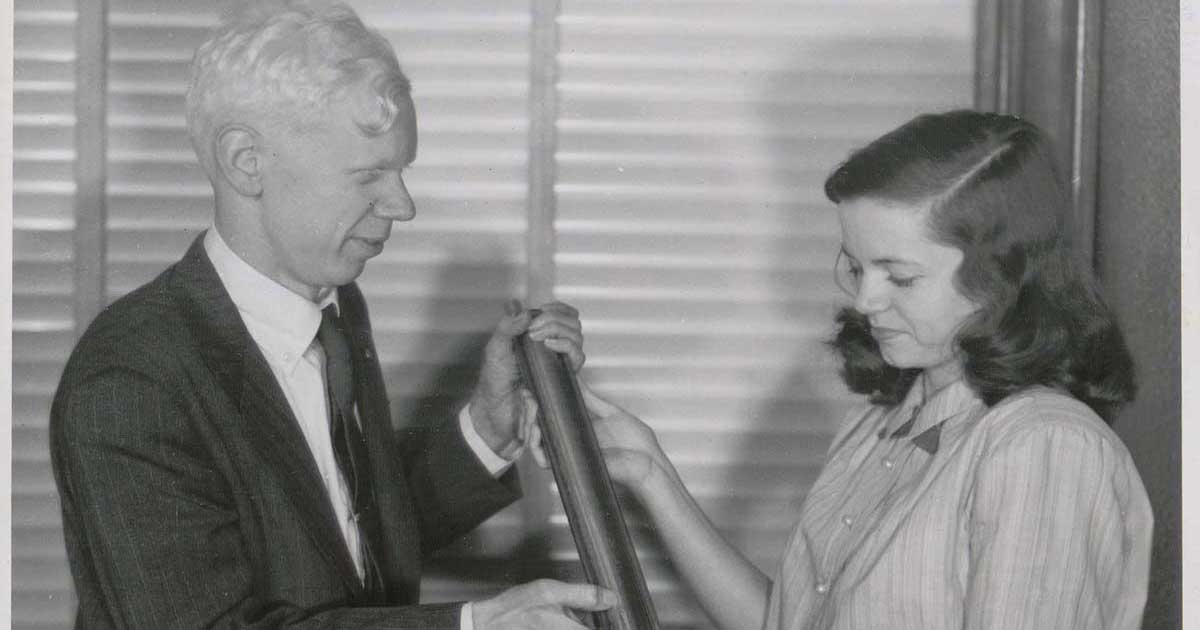
My mother told me she helped design the plug-in vacuum tube memory chassis for UNIVAC. She was a mechanical engineer at the Eckert-Mauchly Computer Corporation starting in 1949. She went by Betty.
I believed her. But belief and evidence are different things, and this archive tries to work with evidence.
Recently I found a collection of official photographs taken by EMCC itself, now held at the Hagley Museum and Library in Wilmington, Delaware. They document the UNIVAC memory system — specifically the mercury delay line memory tanks and the chassis that housed the electronics around them. These photographs were taken around 1951, during the period Betty was working there.
When I looked at what was in those photographs, I understood for the first time what she had actually been making.
What the memory system was
The UNIVAC used an approach to memory called acoustic delay line storage. A mercury-filled cylindrical tank received electrical pulses at one end. Those pulses traveled through the mercury as sound waves. When they reached the other end, they were detected, amplified, and recirculated. This kept data alive in a continuous loop as long as the machine was running.
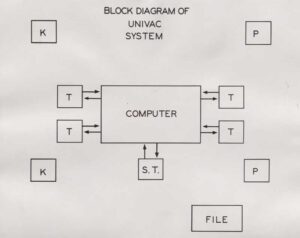
Each memory tank stored data for 20 words of 12 decimal digits each. Two tanks together gave the machine 40 words of high-speed working memory. That was the entire short-term memory of the first commercial computer in the United States.
The tanks didn’t work alone. Surrounding each tank was a chassis — a mechanical frame holding the amplifiers, switching circuits, and vacuum tubes that drove, detected, and managed the pulses moving through the mercury. That chassis was a precision mechanical assembly. It had to hold tight tolerances, allow quick access for tube replacement, and remain stable under operating heat.
That’s the mechanical engineering problem. That’s what Betty was working on.
What the photographs show
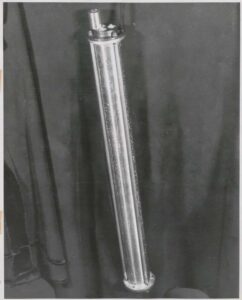
This is what a memory tank looked like by itself. It’s a precision-machined aluminum cylinder, roughly two feet long, with crystal transducers fitted at each end. The mercury inside had to be maintained at a carefully controlled temperature — slightly less than 208 microseconds worth of acoustic path length — or the timing would drift and data would be lost.
The EMCC documents describe the temperature control system as part of the tank assembly itself. Getting the mechanical tolerances right on that kind of thermally sensitive precision component was not a simple job.
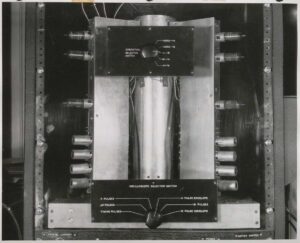
This photograph shows clearly what a plug-in vacuum tube chassis looked like in context. The mercury tank sits in the center. On each side, rows of miniature vacuum tubes are mounted in removable chassis frames. Each chassis plugs into the unit independently, allowing a faulty tube or circuit to be pulled and replaced without shutting the whole system down. The EMCC documentation specifically notes that the chassis construction made all parts easily accessible for testing and quick replacement.
That design philosophy — accessible, modular, field-serviceable — was a deliberate mechanical engineering choice. It didn’t happen automatically. Someone had to design the frame geometry, the connector tolerances, the mounting strategy.
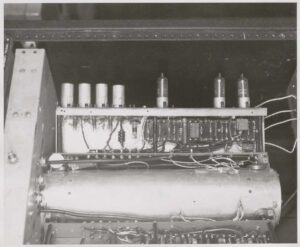
This is as close as the documentary record gets to what Betty’s hands were working on. The plug-in chassis visible here — the frame, the tube mounting, the layout — is the category of component she described helping design.
I can’t prove her specific contribution from what survives. Employment records from that period were destroyed in a fire in 1972. What I can say is that she was a mechanical engineer at EMCC from 1949 onward, that EMCC was a small company building exactly this kind of hardware, and that what she described matches precisely what this equipment required.
The scale of the operation
In June 1949, the entire EMCC staff fit in a single photograph. There were 29 people. Betty joined that year.
By the time UNIVAC was delivered to the Census Bureau in 1951, the machine had been through Remington Rand’s acquisition of the company in 1950. Betty stayed through that transition, as did most of the technical staff. The work continued under new ownership, but the engineering team was largely the same people who had been there at Ridge Avenue from the beginning.
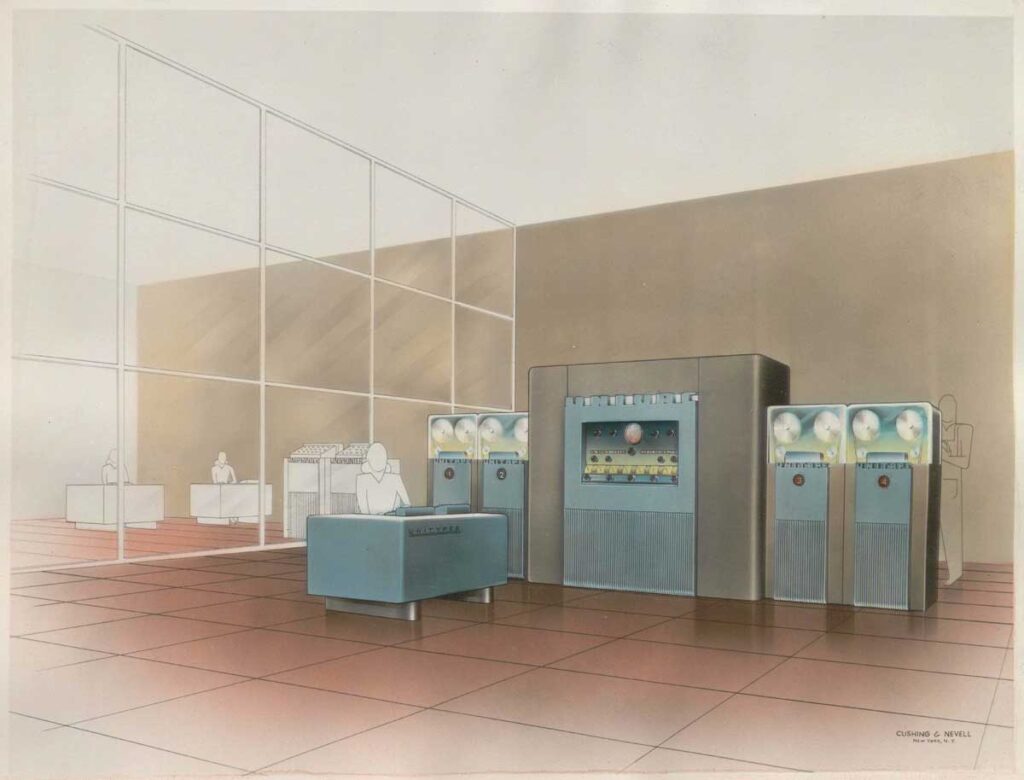
This rendering was how EMCC presented UNIVAC to potential customers. It’s aspirational — clean, modern, organized. The reality of building it was messier. The company ran out of money multiple times. Delivery deadlines slipped. The Census Bureau waited months past the original target date. Through all of it, the engineering team kept working.
Betty’s career at EMCC and its successor companies ran from 1949 through approximately 1963. That span covers the entire arc from the UNIVAC prototype to the mature Sperry Rand computing division. She was there for all of it.
What I’m still looking for
The Hagley Museum and Library holds the main surviving collection of EMCC and UNIVAC Division records — photographs, technical documents, corporate materials. The collection reference is Accession 1985.261, Series I, Eckert-Mauchly Computer Corporation.
If anyone who worked at EMCC, the Eckert-Mauchly Division of Remington Rand, or the UNIVAC Division of Sperry Rand during this period — or who knew someone who did — has memories, photographs, or documents they’d be willing to share, I want to hear from you. Betty’s specific contributions may yet be traceable. Her name may appear in documents that survive outside the ones destroyed in 1972. US patents from the era are one place I’m still looking.
She told me she helped build the memory. I believe her. And now, for the first time, I can show you what the memory looked like.
Source
Sperry Corporation, UNIVAC Division photographs and audiovisual materials (Accession 1985.261). 1951 (year approximate). AVD_1985261_001_007_001. Series I. Eckert-Mauchly Computer Corporation, Subseries A. Univac Philadelphia Records Center photographs, Box 1, Folder 1, Audiovisual Collections, Hagley Museum and Library, Wilmington, DE 19807. Accessed 2026-05-23. https://digital.hagley.org/AVD_1985261_001_007_001